_edited.jpeg)
Equine Bodyworks
By Mary Sargeant MMCP
Whole Horse Bodywork & Equine Education
A horse-first approach to bodywork
Bodywork should never just be about what we want to achieve, it should also be about what the horse is telling us along the way.
My approach has developed over many years of working with horses and focuses on gentle hands-on bodywork, observation and allowing the horse to take an active part in the session.
Rather than working to a fixed routine, I pay attention to the individual horse in front of me, how they move, how they respond and when they may need me to change what I am doing.
The aim is simple, to create an environment where the horse can be listened to rather than worked on.
Alongside equine bodywork I also provide owner education, demonstrations, day courses, online learning and my Easy Equine Anatomy books and resources.

Welcome to Equine Bodyworks by Mary Sargeant MMCP.
My approach to bodywork has always been about looking at the whole horse rather than simply focusing on one area.
Every horse is an individual and every session is guided by the horse in front of me, paying attention to their behaviour, movement and responses along the way.
Listening to the horse is a huge part of how I work. Rather than following a fixed routine or deciding beforehand what a horse needs, I adapt what I am doing according to the information the horse gives me throughout the session.
Sometimes doing less tells us far more than doing more.
Alongside hands-on bodywork, education has become a big part of Equine Bodyworks.
Through courses, demonstrations, online learning, anatomy resources and my Easy Equine Anatomy books, I aim to make equine anatomy easier to understand and encourage owners to become curious about the whole horse — how everything connects and, most importantly, what their own horse may be telling them.
What to Expect From a Visit
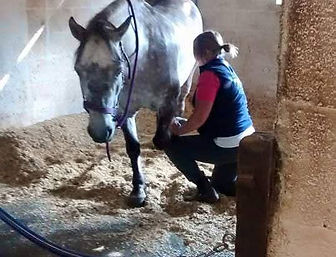
Every horse is an individual and every bodywork session is a little different. I don't work through a fixed routine or arrive with a list of things that must be achieved. I spend time observing the horse, listening to what they are telling me through their behaviour and responses and adapting the session as we go.
The horse is allowed an opinion throughout the session. If something isn't comfortable, they need more time or they simply aren't happy with what I am doing, I would much rather change my approach than insist on completing a technique.
Before Your Appointment
Please make sure your horse is reasonably clean and mud free before I arrive.
If possible, access to a stable or another quiet, safe area is preferred. I will also need access to a safe, reasonably level surface where I can observe your horse moving.
A horse information and consent form should be completed before the session. This gives me some background about your horse and anything I may need to be aware of before we begin.
Please let me know beforehand about any behavioural considerations. This isn't about labelling a horse as difficult or naughty — it simply helps me make sensible decisions about how I approach them and keeps everyone involved safe.
Veterinary Care & Bodywork
Routine maintenance bodywork can be provided to a healthy horse without prior veterinary referral. Your horse must, however, be registered with a veterinary practice.
If your horse is currently under veterinary care, has a known or suspected injury or condition, or has developed an unexplained change in movement, behaviour or general wellbeing, please speak to your veterinary surgeon before arranging a bodywork session. Veterinary involvement or referral may be required before I can proceed.
I do not diagnose veterinary conditions. If something I observe gives me reason to be concerned that there could be an underlying injury, disease or pathology, I will stop or postpone the bodywork and ask you to contact your veterinary surgeon.
Bodywork should never be used as a substitute for veterinary diagnosis or treatment.
When I May Postpone or Stop a Session
There will occasionally be times when bodywork simply isn't appropriate. This may be apparent before the appointment or I may decide not to continue after meeting your horse.
Please contact me before your appointment if your horse:
-
Appears generally unwell
-
Has an unexplained change in movement or suspected lameness
-
Has a recent injury, wound or unexplained swelling
-
Has developed hives or a sudden skin reaction
-
Has unusual discharge from the eyes or nose alongside signs of illness
-
Has or may have been exposed to an infectious or contagious disease such as strangles or equine influenza
-
Is showing signs that could indicate colic or another acute health concern
-
Is currently undergoing veterinary investigation or treatment
-
Is pregnant
This list isn't intended to diagnose what might be wrong with a horse. It simply gives some examples of situations where veterinary advice should come before bodywork.
If I have concerns when I arrive, I may decide not to start the session. Equally, if something concerns me during a session, I will stop. Starting an appointment never means that we have to finish it regardless of what the horse is telling us.
If you're unsure whether an appointment is appropriate, please ask before booking. If there is a health concern, your veterinary surgeon should always be your first point of contact.
Photographs
I may occasionally take photographs during a session for my own records or educational purposes.
Photographs identifying you or your horse will not be used publicly for my website, social media or educational material without your permission. If you would prefer no photographs to be taken at all, simply let me know.
Payment
Payment is due on the day of the appointment.
I don't automatically put every horse onto the same three-month schedule. Horses are individuals and circumstances change, so any future appointment can be discussed according to the individual horse.
Before I Leave
I'm always happy to talk through what I have observed during the session and answer questions about the bodywork.
What I won't do is diagnose a condition or tell you that your horse has a particular injury or veterinary problem. If something falls outside my professional scope, I will tell you and recommend that you discuss it with the appropriate professional.
My role is bodywork. Your vet's role is veterinary diagnosis and treatment. Keeping that distinction clear is important for me, for you and most importantly for your horse.